
As part of the NL-ECO project, we are developing bio-inspired touch probe for material recognition based on main tactile descriptors – roughness, hardness and slipperiness.
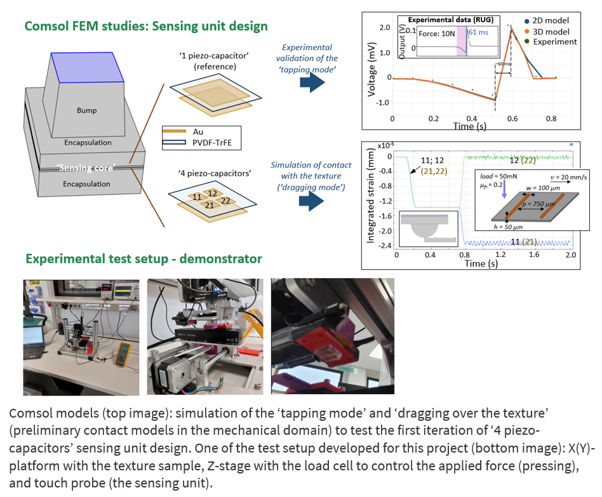
Human sense of touch is based on various mechanoreceptors embedded in the skin, that guide our interactions with environment and provide essential information about properties of the objects we touch. Within “Tactile Internet” research activity in NL-ECO project we are developing touch probe that mimics so called Pacinian corpuscles, which respond to pressure and dynamic vibrations to decode the tactile properties. Our research has showed that one of the best options to emulate the flexibility and conformability of human skin together with sensing corpuscles’ density and resolution – is to use piezoelectric-polymer sensing technology. The proposed sensing unit consists of a PVDF-TrFE piezoelectric layer sandwiched between four patterned electrodes on one side and a continuous electrode on the other, complemented by an encapsulation layer and a surface bump. Dragging this probe over the surface generates distribution of the reaction forces and thus induces charge variations on each of the four ‘piezo-capacitors’ by direct piezoelectric effect. Analyzing their read-out signal information about different textures, i.e. their roughness, hardness and slipperiness, is derived.
The assignment
This research assignment will be built around COMSOL Multiphysics, i.e. development and validation of the simplified yet robust models to optimize the touch probe design and give us a better insight into our experimental approach.
In our NL-ECO project we are closely collaborating with two research groups from University of Groningen (RUG) and Fontys. You will be part of this collaboration and involved in the regular meetings of our touch probe design working group.
Main activities
You will work on the following activities:
- COMSOL Multiphysics: developing models that emulate mechanical contact of the touch sensing unit (the second iteration design) with the texture, performing parametric sweeps (e.g., compare different bump shapes/sizes, add an extra spacer between the sensing unit and its holder, etc.) to optimize the probe design, transferring output into electrical domain akin to our experiments and extending to different textures.
- Experimental validation/data analysis: performing experiments at Saxion or receiving data from our project partners from RUG (if the setup is used there at that moment), analyzing the data and using them to refine and validate the models.
- Database development: extract primary descriptors of the various textures and build the database which can be used for prediction and binning of the new materials.
Literature research/methodology (together with project partners): if necessary, make an additional literature research to refine the proposed methodology for the primary tactile descriptors (we are always open to new ideas).
Project duration:
START: 01-02-2027
END: 10-07-2027
Internship or graduation project:
Open for internship or graduation project
Educational programs:
- Applied Physics,
- Alternatively, a related technical study.
Interested? Please send your motivation letter and CV before the 18th of December 2026 to appliednanotechnology.led@saxion.nl and include Yulia Tykhonenko-Polishchuk (y.tykhonenko@saxion.nl) in the CC.