
As part of the Meteorite 2 project, we are designing the test structures and methodology to determine thermal material properties based on which we can approve the thermal flow meters (products) at an early stage in their fabrication process flows.
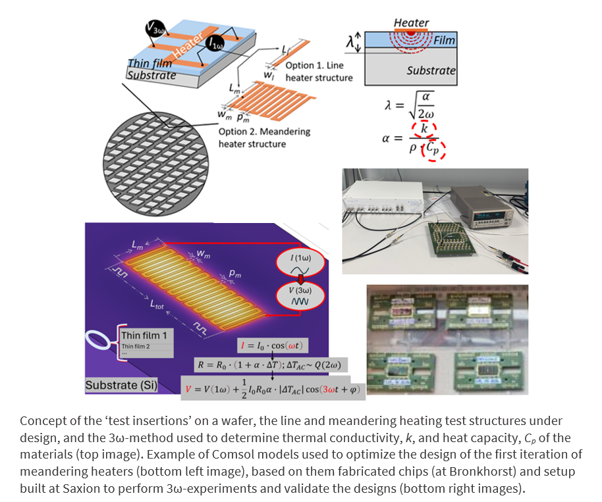
Thermal flow meters represent a vast range of sensors for applications in oil and gas, sustainable energy, food and medical care markets. As a part of MEMS technology, these sensors are produced on wafers (front-end), sawn into individual chips (dice, back-end), assembled into modules (assembly), and only then the product is tested. Due to high customization of these sensors, there are no common tests that can be ‘inserted’ into the production flow at earlier stages. For some products this results in only half of the chips being approved after testing (low yield, high waste). In Meteorite 2 research project we develop the test insertions on a wafer (the test structures and methodology) to determine effective material properties and serve as monitors of wafers quality after front-end. Specifically, we target the thermal properties of the flow meter’s material stack, i.e. thermal conductivity and heat capacity. For this we use so called 3ω-method, where we drive conductive structures by AC current with 1ω frequency and reading the third harmonic 3ω in the resulting voltage drop. The 3ω harmonic contains information about the thermal properties, however the methodology to extract them is not straightforward and highly depends on the test structures designs.
The assignment
This research assignment will be built around COMSOL Multiphysics, i.e. development and experimental validation of the COMSOL models to optimize the test structures designs and give us a better insight into our methodology.
In our Meteorite 2 project we are closely collaborating with two industrial project partners, Bronkhorst High-Tech and Salland Engineering. You will be involved in our meetings with the R&D team.
Main activities
You will work on the following activities:
- COMSOL Multiphysics: develop electro-thermal coupled physics models, akin to our experiments, to optimize the existing iteration of the test structures or develop thermal models for the new test structures.
- Experimental validation/data analysis: performing experiments at Saxion or receiving data from our project partners (depending on the models complexity and time), analyzing the data and using them to refine and validate the models.
Literature research and methodology: the test methodology (the analytical formulas), used for determination of thermal properties highly depends on the test structure design and has to be adjusted for each iteration (e.g., one can think of cross-plane vs. in-plane ways for thermal wave to penetrate the materials and thus affect their properties). For this an additional literature research will be involved.
Project duration:
START: 01-02-2027
END: 10-07-2027
Internship or graduation project:
Open for internship or graduation project
Educational programs:
- Applied Physics,
- Alternatively, a related technical study.
Interested? Please send your motivation letter and CV before the 18th of December 2026 to appliednanotechnology.led@saxion.nl and include Yulia Tykhonenko-Polishchuk (y.tykhonenko@saxion.nl) in the CC.